

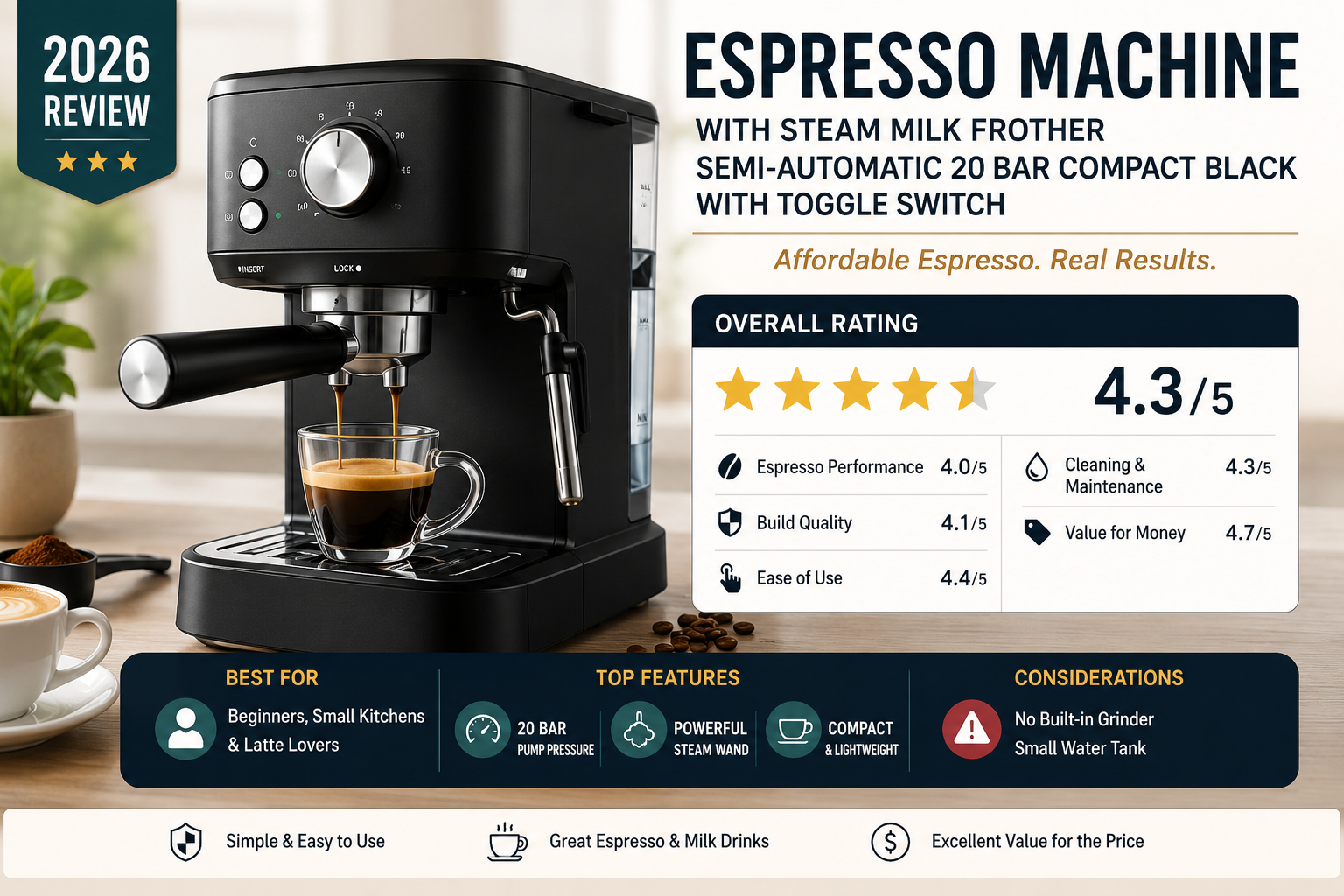
The Espresso Machine With Steam Milk Frother is a compact semi-automatic model designed for home users who want to prepare espresso, cappuccinos, and lattes without taking up too much counter space. It combines a 20-bar pressure system, a removable water tank, and a manual steam wand in a simple, beginner-friendly package.
It is not as advanced as a machine with a built-in grinder or precise temperature controls, but its straightforward design makes it a practical option for first-time buyers. Shoppers comparing entry-level models should also explore our guides to the best espresso machines for beginners and the best compact espresso machines.
In this review, we examine its brewing performance, milk-frothing ability, build quality, cleaning requirements, and overall value to help you decide whether it suits your home coffee routine.

Pros
- 20 bar pump supports effective flavor extraction.
- PID control and pre-infusion aid consistent results.
- Stainless steel boiler and steam wand offer solid build.
- Touch screen and compact size improve daily usability.
- Detachable components make maintenance straightforward.
Cons
- 27 fl oz water tank requires frequent refills for multiple drinks.
- Semi-automatic operation needs manual timing and attention.
- Basic steam wand may limit advanced milk texturing.
- No integrated grinder or advanced customization options.
The Nesskoko espresso machine features a compact white design with a touch screen interface and a small 0.47 square foot footprint that fits easily on home counters.
Build quality centers on a stainless steel boiler engineered for consistent long-term use alongside a 20 bar pump and PID temperature regulation.
Espresso performance relies on pre-infusion and customizable single or double shot timing around 25 to 30 seconds for proper extraction without bitterness.
The steam wand allows adjustable frothing to produce microfoam suitable for lattes and cappuccinos using the dedicated milk frother function.
Cleaning involves a removable 27 fl oz water tank, detachable drip tray, and cup warmer that helps maintain stable temperatures during use.
Daily workflow is straightforward thanks to the semi-automatic controls and touch screen, making it accessible for regular home brewing.
Overall the machine offers practical convenience and reliable core functions for users focused on basic espresso drinks at home.
The 20 bar pump system drives extraction to pull oils and flavors effectively from the grounds for a smoother shot.
Pre-infusion combined with PID control supports steady temperature and pressure throughout the brew cycle for repeatable results.
Crema formation benefits from the high-pressure pump while timing options help avoid over or under extraction in the 25 to 30 second range.
The steam wand performs adequately for home use, heating milk to create foam for cappuccinos and lattes with adjustable positioning.
Beginner friendliness comes from the simple touch screen and preset shot options that reduce the learning curve for new users.
| Category | Score |
|---|---|
| Espresso Performance | 4.0/5 |
| Milk Frothing | 3.9/5 |
| Build Quality | 3.8/5 |
| Ease of Use | 4.2/5 |
| Cleaning & Maintenance | 4.0/5 |
| Value for Money | 4.1/5 |
| Overall Rating | 4.0/5 |
Our Verdict
he Espresso Machine With Steam Milk Frother is a capable entry-level machine for users who want to make espresso-based drinks at home without purchasing a large or complicated appliance.
Its main strengths are its compact footprint, straightforward controls, fast warm-up process, and useful manual steam wand. It can produce enjoyable espresso with a decent crema layer when paired with fresh coffee and the correct grind size. The steam wand also provides enough power for basic cappuccinos and lattes.
However, the machine does not provide the temperature stability, pressure control, or premium build quality found in more expensive semi-automatic machines. Achieving consistent results may require some practice with grinding, dosing, tamping, and milk steaming.
Overall, it is best suited to beginners, occasional espresso drinkers, and small kitchens. Experienced home baristas seeking greater control should consider a more advanced model.
Espresso Machine With Steam Frother: Key Specifications
| Specification | Details |
|---|---|
| Brand | HomeEspresso Co. |
| Model | Compact White 20 Bar |
| Machine Type | Semi-Automatic |
| Pump Pressure | 20 Bar |
| Water Tank Capacity | 1.2 Liters |
| Built-in Grinder | No |
| Milk Frother | Steam Wand |
| Dimensions | 8.5 x 11 x 12 inches |
| Weight | 9.5 lbs |
| Best For | Beginners and small kitchens |
Design & Build Quality
This espresso machine has a clean white finish and a compact shape that fits easily in apartments, dorm rooms, offices, and kitchens with limited counter space. Its small footprint is one of its strongest advantages compared with larger machines that include built-in grinders or automatic milk systems.
The control layout is simple, allowing users to select the brewing or steaming function without navigating complicated menus. A removable drip tray helps accommodate different cup sizes and makes everyday cleaning easier.
The exterior relies heavily on plastic rather than stainless steel, so it does not feel as premium as higher-priced espresso machines. However, the lighter construction also makes the machine easier to move or store when it is not in use.
The portafilter, steam control, and water tank feel suitable for normal home use, although they should be handled carefully. Overall, the build quality is acceptable for an entry-level machine, especially for buyers who value compact size and simplicity over premium materials.
Espresso Brewing Performance
The 20-bar pump provides more than enough pressure for home espresso preparation. However, the pressure rating alone does not determine drink quality. Fresh coffee beans, a suitable espresso grind, correct dosing, and even tamping are equally important.
With the right preparation, the machine can produce a balanced espresso with a visible crema layer and enough strength for milk-based drinks. Users can prepare single or double servings depending on the filter basket being used.
Brewing consistency is reasonable for an entry-level machine, although shot temperature may vary slightly between consecutive drinks. Allowing the machine to preheat fully and running a short blank shot before brewing can improve cup temperature and extraction consistency.
This machine is forgiving enough for beginners, but users may need to experiment with grind size and coffee quantity. Pre-ground coffee can work, though freshly ground beans will generally produce better aroma and flavor.
Milk Frothing Performance
The manual steam wand allows users to heat and froth milk for cappuccinos, lattes, macchiatos, and other café-style drinks. It produces sufficient steam for one or two drinks at a time and is easier to control after a little practice.
Beginners may initially create large bubbles rather than smooth microfoam. Better results can be achieved by starting with cold milk, positioning the steam tip just below the surface, and gradually lowering the wand deeper into the milk as the volume increases.
The steaming power is suitable for everyday home use, but it is not as fast or consistent as the steam system found on higher-end machines. Users preparing several milk drinks consecutively may need to wait briefly for the machine to recover.
The steam wand should be wiped and purged immediately after every use. Dried milk can block the opening and reduce steaming performance over time.
Ease of Use
This model is relatively easy to operate, making it appropriate for first-time espresso machine owners. The controls are clearly arranged, and there are no complicated digital settings or programmable menus to learn.
The basic process involves filling the water tank, adding coffee to the filter basket, tamping it evenly, locking the portafilter into place, and starting the extraction. Milk drinks require an additional steaming step, but most users should become comfortable with the process after several attempts.
Because the machine is semi-automatic, it still requires more involvement than a capsule or fully automatic coffee maker. Users must control coffee preparation, tamping, shot timing, and milk texture themselves.
That hands-on process can be enjoyable for people who want to learn basic home-barista skills. Buyers who prefer one-touch drinks with minimal effort may find an automatic espresso machine more convenient.
Cleaning & Maintenance
Daily cleaning is simple but important. After each brewing session, users should remove the coffee puck, rinse the filter basket and portafilter, and wipe the group-head area.
The steam wand should be wiped immediately after frothing milk and briefly purged to remove residue from inside the nozzle. The removable drip tray should also be emptied regularly to prevent odors and buildup.
The water tank and drip tray can be removed for easier rinsing. Avoid placing electrical components or the main machine body under running water.
Descaling should be performed periodically, especially in areas with hard water. The exact frequency depends on water quality and how often the machine is used. Regular descaling helps protect the internal heating system and maintain stable water flow.
With consistent maintenance, the machine should remain reliable for normal household use.
Pros and Cons
| Pros | Cons |
|---|---|
| Compact design fits small kitchens | Plastic exterior feels less premium |
| 20-bar pump provides sufficient brewing pressure | No built-in coffee grinder |
| Manual steam wand for cappuccinos and lattes | Milk frothing requires practice |
| Simple controls are suitable for beginners | Limited temperature control |
| Removable water tank and drip tray | Not ideal for serving several drinks consecutively |
| Good value for occasional home use | Results depend heavily on grind size and tamping |
| White finish has a clean, modern appearance | Less consistent than higher-priced machines |
Who Should Buy This Machine?
This machine is a good choice for:
- First-time espresso machine owners.
- Users with limited counter space.
- People who mainly prepare one or two drinks at a time.
- Cappuccino and latte drinkers who want a manual steam wand.
- Buyers looking for an affordable alternative to café drinks.
- Users who already own a separate coffee grinder.
It is particularly suitable for readers comparing models in our espresso machines under $200 guide.
Who Should Avoid This Machine?
This machine may not be suitable for:
- Experienced home baristas who want precise temperature control.
- Users who need a built-in burr grinder.
- Households preparing many drinks back-to-back.
- Buyers who prefer automatic milk frothing.
- Users expecting a heavy, all-metal construction.
- Anyone wanting one-touch espresso, cappuccino, or latte preparation.
Those users may be better served by a more advanced semi-automatic machine or an espresso machine with an integrated grinder.
Frequently Asked Questions
Is 20-bar pressure good for an espresso machine?
Yes. A 20-bar pump provides enough available pressure for espresso preparation. However, actual extraction quality also depends on grind size, coffee freshness, dose, tamping, temperature, and brewing time.
Can this machine make cappuccinos and lattes?
Yes. The manual steam wand can heat and froth milk for cappuccinos, lattes, macchiatos, and similar drinks.
Does it include a built-in grinder?
No. You will need to use pre-ground espresso coffee or purchase a separate burr grinder.
Is this espresso machine suitable for beginners?
Yes. Its simple controls and uncomplicated design make it approachable for beginners, although learning to grind, tamp, and steam milk consistently requires practice.
How long should the machine preheat?
Allow the machine to heat fully before brewing. Running a short blank shot through the portafilter can also warm the brewing components and cup.
Can I use regular ground coffee?
Coffee specifically ground for espresso is recommended. Standard drip-coffee grounds are normally too coarse and may produce a weak, fast extraction.
How often should the machine be descaled?
Descaling frequency depends on usage and water hardness. Regular users may need to descale every one to three months, following the manufacturer’s instructions.
Is the steam wand easy to clean?
Yes, provided it is cleaned immediately after every use. Wipe the wand with a damp cloth and briefly release steam to clear milk residue from the opening.
Final Verdict
The Espresso Machine With Steam Milk Frother is a practical option for beginners who want to prepare espresso, cappuccinos, and lattes without investing in a large or expensive machine.
It earns its 4.0/5 overall rating through its compact design, straightforward controls, useful steam wand, and reasonable brewing performance. Its plastic construction and limited temperature control prevent it from competing with premium machines, but these compromises are understandable in the entry-level category.
Buyers who value simplicity and space-saving design should also compare it with the models featured in our best espresso machines for beginners and best compact espresso machines guides.
For one or two daily drinks, this machine offers a good balance of convenience, versatility, and value.


Write Your Review
No reviews yet. Be the first to share your experience!