
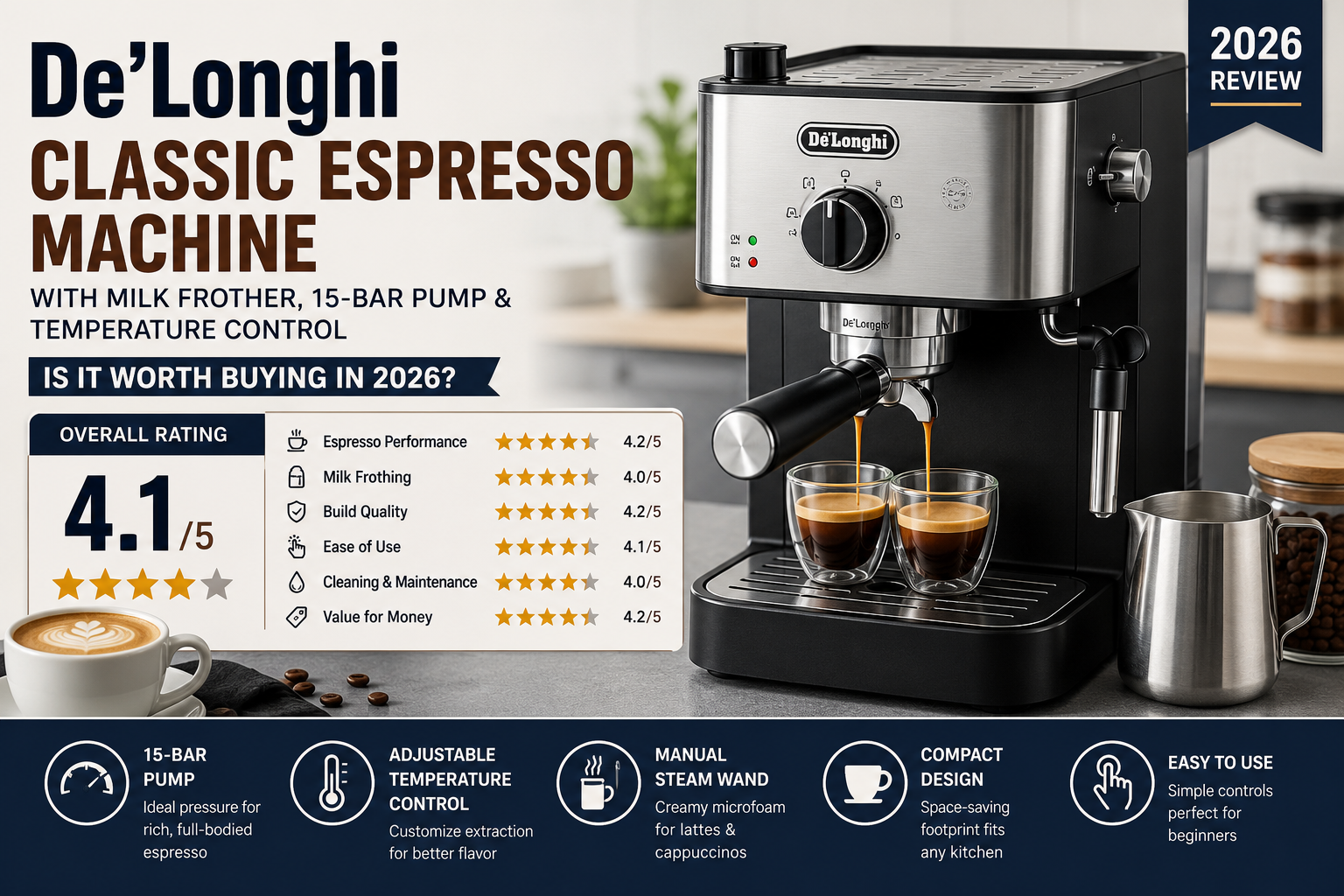
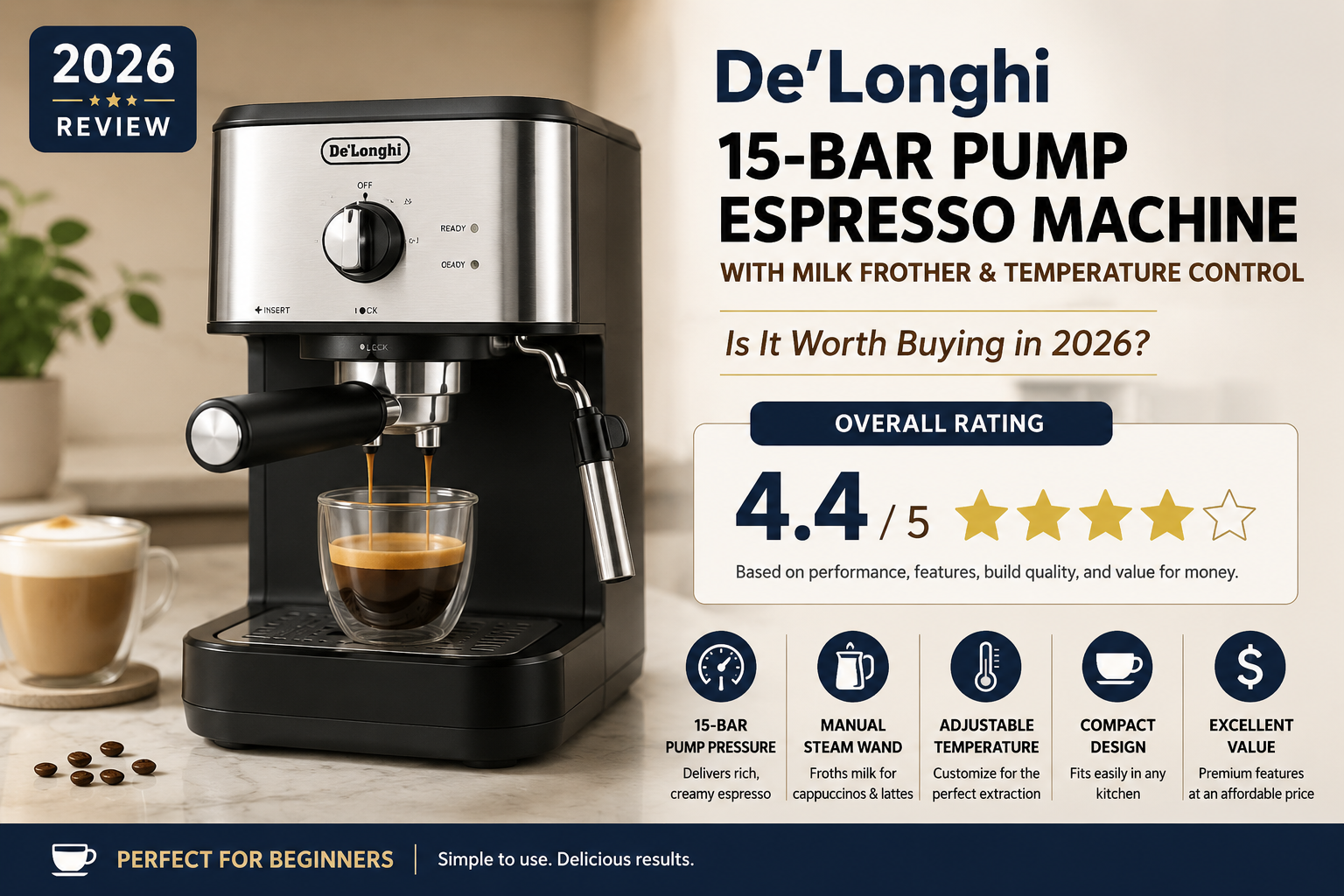
The De’Longhi Classic Espresso Machine combines a 15-bar pump, adjustable temperature control, and a manual milk frother in a compact countertop design. It is intended for home users who want more control than a pod machine without moving into a large or complicated espresso setup.
In this review, we examine its espresso performance, milk-frothing capability, ease of use, cleaning requirements, and overall value to help you decide whether it fits your daily coffee routine.

Pros
- Thermoblock technology delivers quick and stable brewing temperatures
- Pressure gauge helps monitor and improve shot quality in real time
- Adjustable steam settings accommodate different milk textures effectively
- Customizable presets reduce daily setup time for regular users
Cons
- No built-in grinder requires buying one separately
- Manual steam wand demands some practice for top results
- Water tank location can feel awkward during frequent refills
The De'Longhi Classic features a clean stainless steel build that feels solid and looks sharp in most kitchens without taking up much space.
Espresso extraction performs reliably thanks to the 15-bar pump and real-time pressure gauge, helping users dial in better shots over time.
The adjustable steam wand handles both basic steaming and finer microfoam work, though results improve with practice on milk texture.
Daily operation stays straightforward with presets and simple controls, while the removable tank and drip tray make basic cleaning manageable.
Overall this model offers solid value for those wanting cafe-style drinks without complex features or large footprints.
Shot consistency holds steady across multiple pulls with good temperature stability from the Thermoblock system.
Crema forms nicely on well-prepared espresso when pressure stays in the ideal range shown by the gauge.
Steaming performance supports both quick lattes and slower microfoam work depending on the wand setting chosen.
The workflow feels approachable for newer users once the initial setup and first few shots are complete.
Overall Rating
| Category | Rating |
|---|---|
| Espresso Performance | 4.2/5 |
| Milk Frothing | 4.0/5 |
| Build Quality | 4.2/5 |
| Ease of Use | 4.1/5 |
| Cleaning & Maintenance | 4.0/5 |
| Value for Money | 4.2/5 |
| Overall Rating | 4.1/5 |
Rating summary: A compact and approachable manual espresso machine for beginners and casual home users who want adjustable temperature control and a traditional steam wand.
Who It’s Best For
| Who It’s Best For | Who Should Look Elsewhere |
|---|---|
| Beginners learning to brew espresso with ground coffee | Users who want fully automatic, one-touch drinks |
| Latte and cappuccino drinkers who prefer a manual frother | Experienced users seeking advanced pressure profiling |
| Homes with limited countertop space | Households that regularly prepare several drinks back-to-back |
| Buyers who want adjustable brewing temperature | Anyone who wants a built-in coffee grinder |
Our Verdict
The De’Longhi Classic Espresso Machine offers a useful balance of simplicity, control, and compact design. Its 15-bar pump supports espresso brewing, while the adjustable temperature settings provide more flexibility than many basic entry-level machines.
The manual steam wand is suitable for preparing cappuccinos and lattes, although beginners will need some practice to create consistent milk texture. The machine is relatively easy to understand, and its compact footprint makes it suitable for kitchens with limited counter space.
Its main limitations are the absence of a built-in grinder and the hands-on workflow. Users must grind, dose, tamp, brew, and froth manually. It also lacks the advanced control and temperature stability offered by more expensive enthusiast machines.
Overall, it is a strong option for beginners and casual espresso drinkers who want a recognizable brand, manual milk frothing, and useful temperature control without buying a large espresso machine.
Key Specifications
| Specification | Details |
|---|---|
| Brand | De’Longhi |
| Model | Classic Espresso Machine with Milk Frother |
| Machine Type | Manual Espresso |
| Pump Pressure | 15 Bar |
| Water Tank Capacity | 1.1 Liters |
| Built-in Grinder | No |
| Milk Frother | Yes, Steam Wand |
| Dimensions | 7.2 x 9.5 x 11.9 inches |
| Weight | 9.8 lbs |
| Best For | Home beginners and small kitchens |
Design & Build Quality
The De’Longhi Classic Espresso Machine uses a compact vertical design that fits more easily into smaller kitchens than many grinder-equipped espresso machines. Its control panel keeps the main brewing functions within easy reach, while the front-mounted group head and side steam wand create a familiar manual espresso workflow.
The exterior combines practical materials with metallic accents, giving the machine a cleaner appearance than many entry-level models. The portafilter, drip tray, water reservoir, and steam wand are arranged logically, although space around the steam wand may feel limited when using a larger milk pitcher.
The machine feels designed for regular household use rather than high-volume brewing. Its compact body is an advantage for casual users, but buyers preparing several drinks in succession may prefer a larger machine with stronger steaming capacity and greater thermal stability.
Overall, the construction is appropriate for its category and should suit users who prioritize a small footprint, straightforward controls, and a recognizable De’Longhi design.
Espresso Brewing Performance
The 15-bar pump provides sufficient pressure for home espresso, while the adjustable temperature settings allow users to make small changes based on roast level and taste preference. Once the grind size, dose, and tamp are properly adjusted, the machine can produce balanced espresso with enough body for both straight shots and milk drinks.
Results still depend heavily on coffee freshness and preparation. Users without a suitable burr grinder may find it harder to achieve consistent extraction.
Milk Frothing Performance
The manual steam wand can heat and texture milk for cappuccinos, lattes, and other espresso-based drinks. It offers more control than an automatic frother, but creating smooth microfoam requires practice with pitcher position, steam depth, and timing.
It is best suited to preparing one or two milk drinks at a time rather than serving several drinks continuously.
Ease of Use
The controls are straightforward, making the machine approachable for users new to manual espresso. Brewing still requires grinding coffee, filling and tamping the portafilter, starting the extraction, and frothing milk separately.
The adjustable temperature control adds flexibility without making the workflow overly complicated. However, buyers seeking one-touch cappuccinos or automatic grinding should consider a fully automatic model instead.
Cleaning & Maintenance
Rinse the portafilter and filter basket after brewing, empty the drip tray regularly, and wipe the group-head area to remove loose grounds. The steam wand should be wiped and purged immediately after every milk drink.
The machine also requires periodic descaling, particularly in areas with hard water. Consistent cleaning helps maintain water flow, steam performance, and espresso flavor.
Pros and Cons
| Pros | Cons |
|---|---|
| Compact design fits smaller countertops 15-bar pump supports home espresso brewing Adjustable temperature settings Manual steam wand for cappuccinos and lattes Simple controls suitable for beginners Recognizable and established espresso-machine brand Suitable for both single and double shots | No built-in coffee grinder Requires manual dosing and tamping Milk frothing takes practice Not designed for one-touch drinks Limited advanced brewing control Better suited to one or two drinks at a time Requires regular steam-wand cleaning and descaling |
Frequently Asked Questions
Is the De’Longhi Classic Espresso Machine suitable for beginners?
Yes. Its controls are relatively straightforward, although beginners will still need to learn basic grinding, dosing, tamping, and milk-frothing techniques.
Does it include a built-in coffee grinder?
No. A separate burr grinder is recommended for achieving more consistent espresso extraction.
Can it make cappuccinos and lattes?
Yes. The manual steam wand can heat and texture milk for cappuccinos, lattes, and similar espresso-based drinks.
What is the benefit of adjustable temperature control?
Temperature adjustment allows users to fine-tune brewing for different coffee roasts and personal taste preferences.
Does the 15-bar pump guarantee good espresso?
No. Pump pressure is only one part of espresso preparation. Grind size, coffee freshness, dose, tamping, and extraction time also have a major effect on flavor.
Can it use pre-ground coffee?
Yes. However, freshly ground coffee from a suitable burr grinder generally produces better flavor and more consistent extraction.
How often should the steam wand be cleaned?
Wipe and purge the steam wand immediately after every use to prevent dried milk from building up inside or around the tip.
Final Verdict
The De’Longhi Classic Espresso Machine is a practical choice for home users who want to learn manual espresso without purchasing a large or overly complicated machine. Its compact design, 15-bar pump, adjustable temperature settings, and manual steam wand provide the essential tools for preparing espresso, cappuccinos, and lattes.
It works best for beginners and casual coffee drinkers willing to grind, dose, tamp, and froth milk manually. The absence of a built-in grinder means an additional purchase may be necessary, while users seeking automatic drinks or advanced extraction controls should consider another machine.
Buyers comparing similar models can explore our guide to the best espresso machines for beginners or view more options in our De’Longhi espresso machine roundup.
Overall, this machine offers a good combination of compact size, approachable controls, and hands-on brewing flexibility for everyday home use.
A compact De’Longhi option for learning espresso and preparing homemade milk drinks.

Write Your Review
No reviews yet. Be the first to share your experience!