
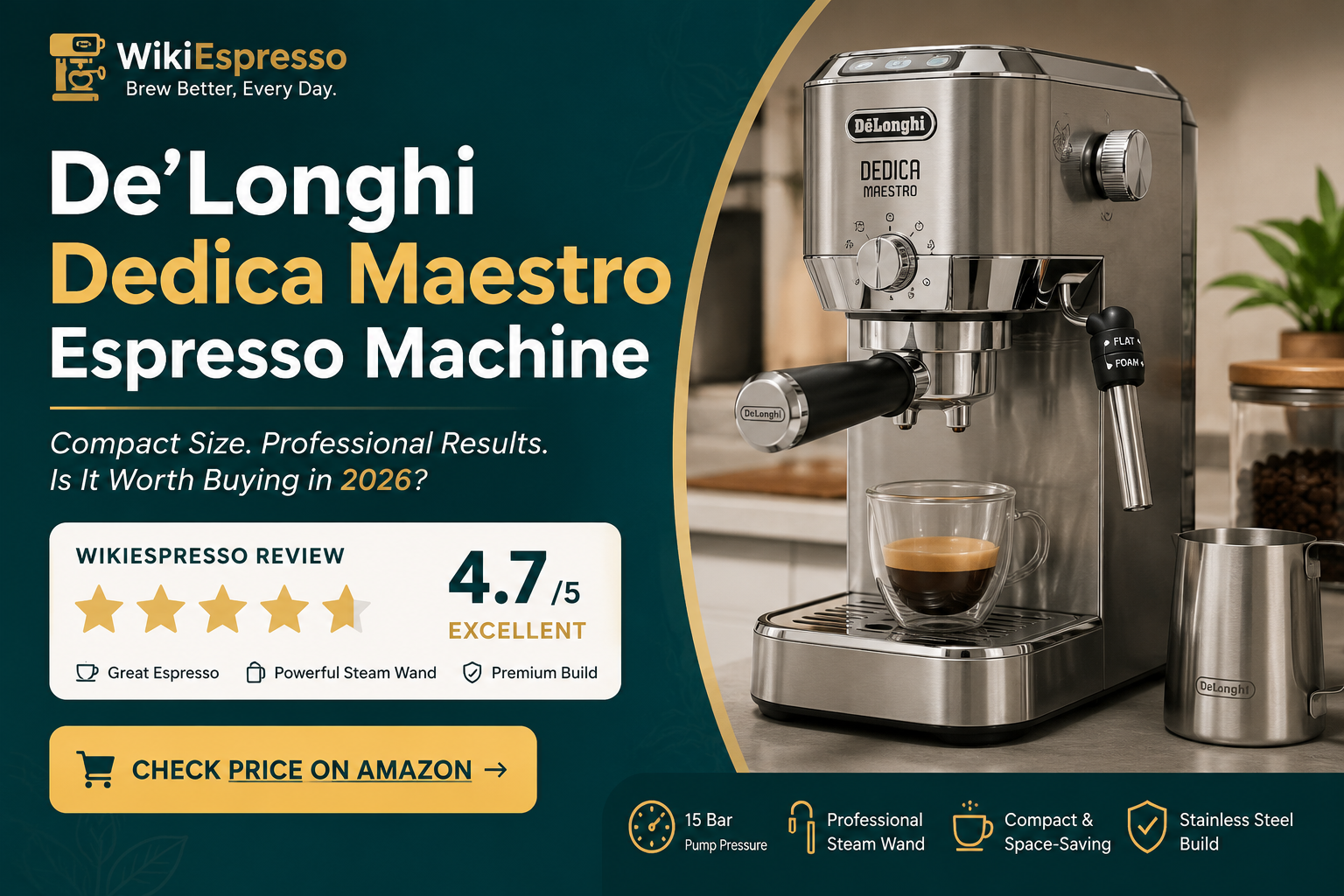
The De’Longhi Dedica Maestro is designed for coffee lovers who want café-style espresso without sacrificing counter space. Combining a slim stainless steel body, a powerful 15-bar pump, and an upgraded commercial-style steam wand, it bridges the gap between beginner-friendly convenience and enthusiast-level control.
In this review, we evaluate its espresso quality, milk frothing performance, ease of use, build quality, and overall value to help you decide whether it’s worth buying in 2026.

Pros
- Quick heat-up time reduces wait between shots
- Compact footprint suits small kitchens without sacrificing build quality
- Adjustable brew temperatures help match different coffee beans
- Strong steam wand delivers usable microfoam with practice
Cons
- Manual milk frothing has a learning curve for new users
- Single-wall baskets require fresh beans and good technique for best results
- No built-in grinder so an extra appliance is needed
- Basic preset options limit one-touch drink variety
The De'Longhi Dedica Maestro features a slim stainless steel body that fits neatly on most counters while still offering a full-size portafilter and steam wand. Build quality feels solid for the category, with clear controls and a removable water tank that makes refills straightforward.
Espresso extraction benefits from the 15-bar pump and active temperature settings, producing shots with decent body when using medium roasts and proper grind size. The included single-wall baskets reward fresh beans and good puck prep with acceptable crema.
Milk frothing performance is capable once users master the commercial-style wand, allowing everything from light microfoam for flat whites to thicker texture for cappuccinos. Heat-up happens in seconds thanks to the Thermoblock system.
Cleaning stays simple with the stainless finish and dishwasher-safe components. The machine suits users who value manual workflow over automation and appreciate its space-saving size.
Shot consistency holds steady across multiple pulls when the machine is preheated and the grind is dialed in correctly. Crema develops reliably with fresh medium-roast beans though it may appear thinner with darker or older coffee.
The steam wand heats quickly and provides enough power for small pitchers, creating usable microfoam after a short learning period. Temperature stability benefits from the three selectable brew settings that adapt to different beans.
Overall workflow feels efficient for a compact manual machine, though beginners should expect to practice milk steaming and dosing for repeatable results. The presets for single and double shots add convenience without overcomplicating the process.
| Category | Rating |
|---|---|
| Espresso Performance | ⭐⭐⭐⭐⭐ (4.8/5) |
| Build Quality | ⭐⭐⭐⭐⭐ (4.8/5) |
| Ease of Use | ⭐⭐⭐⭐☆ (4.6/5) |
| Cleaning & Maintenance | ⭐⭐⭐⭐⭐ (4.8/5) |
| Value for Money | ⭐⭐⭐⭐☆ (4.7/5) |
| Overall Rating | ⭐⭐⭐⭐⭐ (4.7/5) |
Our Verdict
The De’Longhi Dedica Maestro delivers impressive espresso quality in a remarkably compact footprint. Its upgraded steam wand offers more control than typical entry-level machines, while the premium stainless steel design feels durable and modern.
Although it doesn’t include a built-in grinder and requires a quality burr grinder for the best results, it remains one of the strongest compact espresso machines in its price range. For home baristas seeking better milk texture and greater brewing control without investing in a large prosumer machine, the Dedica Maestro is an excellent choice.
The Dedica Maestro stands out because it balances compact dimensions with espresso quality that exceeds expectations for its size. While it requires a separate grinder, the machine offers excellent temperature stability and a capable steam wand, making it a strong long-term option for home baristas.
Key Specifications
| Specification | Details |
|---|---|
| Brand | De’Longhi |
| Model | Dedica Maestro |
| Machine Type | Manual Espresso |
| Pump Pressure | 15 Bar |
| Water Tank Capacity | 1.0 Liter |
| Built-in Grinder | No |
| Milk Frother | Pannarello Steam Wand |
| Dimensions | 5.9 x 13 x 13 inches |
| Weight | 9.5 lbs |
| Best For | Small kitchens, espresso enthusiasts |
Design & Build Quality
The Dedica Maestro features a slim stainless steel body that occupies minimal counter space while maintaining a premium appearance. Compared with many compact espresso machines, its construction feels more solid, with intuitive controls and a professional-inspired layout.
Despite its lightweight design, the machine remains stable during brewing. The narrow footprint makes it especially attractive for apartments, smaller kitchens, and users who prefer a clean, minimalist coffee station.
Espresso Brewing Performance
Powered by a 15-bar Italian pump and a commercial-style portafilter, the Dedica Maestro consistently produces rich espresso with balanced crema when paired with freshly ground coffee. Temperature stability is improved compared with earlier Dedica models, resulting in more consistent extraction across consecutive shots.
While experienced users will achieve the best results using a dedicated burr grinder, even beginners can produce flavorful espresso after a short learning curve.
Milk Frothing Performance
One of the biggest upgrades is the commercial-style steam wand. Unlike the automatic frothers found on many entry-level machines, it provides greater manual control for creating silky microfoam suitable for cappuccinos, flat whites, and latte art.
Beginners may need some practice, but users willing to develop their steaming technique will appreciate the improved texture and flexibility compared with basic pannarello wands.
Ease of Use
The Dedica Maestro strikes a good balance between simplicity and manual control. Its intuitive button layout, quick heat-up time, and straightforward brewing workflow make it accessible to beginners while still giving experienced users room to refine their technique.
Once familiar with grinding, dosing, and steaming, daily operation becomes fast and consistent.
Cleaning & Maintenance
Routine maintenance is straightforward thanks to the removable drip tray, water tank, and accessible brewing components. Regular descaling and steam wand cleaning help maintain long-term performance, while the stainless steel exterior is easy to wipe clean after daily use.
Overall, maintenance requirements remain low compared with larger semi-automatic espresso machines.
Pros and Cons
| Pros | Cons |
|---|---|
| Premium stainless steel design | No built-in grinder |
| Excellent commercial-style steam wand | Manual milk frothing requires practice |
| Consistent espresso extraction | Smaller water tank than larger machines |
| Compact footprint for small kitchens | Best performance requires a quality burr grinder |
| Fast heat-up time | Higher price than basic Dedica models |
Who Should Buy This Machine?
The De’Longhi Dedica Maestro is ideal for home baristas who want a compact espresso machine with better milk frothing performance and greater manual control than entry-level models. It’s especially well suited for apartment kitchens, beginners looking to improve their skills, and users who already own a quality coffee grinder.
Who Should Avoid This Machine?
If you want a fully automatic brewing experience or expect a built-in grinder, this machine may not be the best fit. Those seeking one-touch milk drinks or maximum convenience should consider a fully automatic espresso machine instead.
Frequently Asked Questions
Is the De’Longhi Dedica Maestro worth buying in 2026?
Yes. It remains one of the best compact semi-automatic espresso machines for users who value espresso quality, manual milk frothing, and premium build quality.
Is it good for beginners?
Yes. Its straightforward controls and quick heat-up time make it approachable for beginners, although mastering milk frothing requires some practice.
Does it include a built-in grinder?
No. You’ll need a separate burr grinder to achieve the best espresso results.
Can it make latte art?
Yes. The commercial-style steam wand is capable of producing fine microfoam suitable for latte art after some practice.
How easy is it to maintain?
Cleaning is simple thanks to removable components and an easy-to-access steam wand. Regular descaling helps maintain long-term performance.
Is it suitable for small kitchens?
Absolutely. Its slim profile is one of the machine’s biggest strengths, making it ideal for limited counter space.
Final Verdict
The De’Longhi Dedica Maestro successfully combines premium design, compact dimensions, and impressive espresso performance in one of the most capable machines in its class. While it requires a separate grinder and a bit of practice to unlock its full potential, the excellent steam wand and consistent brewing results make it a worthwhile upgrade for aspiring home baristas.
If you’re comparing compact espresso machines, also check our Best Espresso Machines Under $300 and Best Espresso Machines for Beginners guides to explore additional recommendations before making your decision.
If you’re looking for a compact espresso machine that prioritizes coffee quality over automation, the Dedica Maestro remains one of the strongest choices in its class.


Write Your Review
No reviews yet. Be the first to share your experience!